
For many years, transport compliance in the European Union has been viewed as the responsibility of the carrier – the company physically moving goods from A to B. The EU Mobility Package changes that assumption entirely.
What we are seeing is a structural shift in the EU from operator-led compliance to shared supply chain accountability. The legislation extends beyond driver welfare and market regulation; it introduces a clear expectation that every party involved in a shipment – from shipper to subcontractor – is accountable for how international transport is planned and executed.
For life science organizations, this shift is particularly significant. These supply chains are already among the most complex and time-critical in the world. This increased compliance risk sits alongside product integrity, temperature control, and patient impact as a core operational concern.
The key regulatory changes shaping 2026
At the center of this transformation are two major developments that will reshape how international shipments are planned and delivered across the EU and UK.
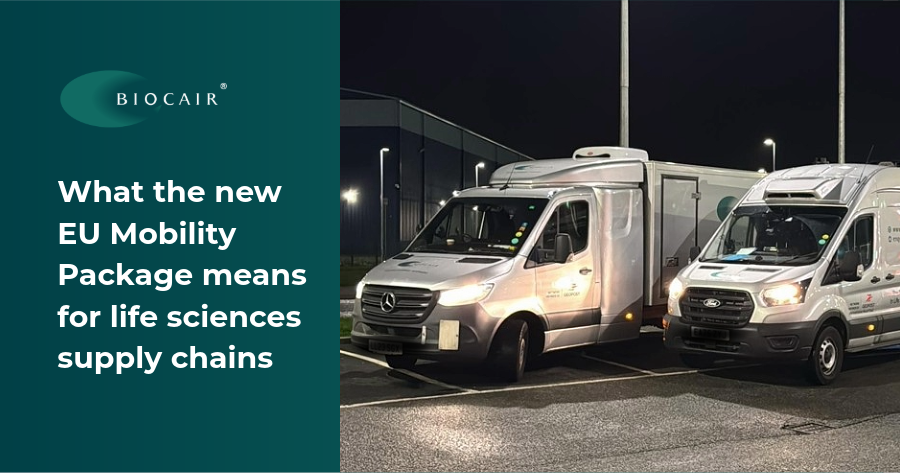
The first is the extension of full regulatory requirements to light commercial vehicles. From 1 July 2026, vans between 2.5 and 3.5 tons operating internationally will be subject to some rules applicable to heavy goods vehicles. This means drivers must adhere to strict limits on driving and working hours, mandatory rest periods, and the use of smart tachographs that record and store activity data. For industries such as life sciences, where vans have long been used as flexible, rapid-response options for urgent shipments, this represents a significant operational change. What was previously a highly agile mode of transport will now need to operate within clearly defined legal constraints.
The second and more transformative change is the enforcement of a true “Chain of Responsibility”. This principle extends legal accountability across the entire supply chain. It means that compliance is no longer confined to the transport provider. Customers, freight forwarders, and subcontractors may be exposed to enforcement action or contractual liability where their decisions contribute to regulatory breaches. This includes situations where delivery schedules are unrealistic, where operational delays push drivers beyond legal limits, or where subcontractors fail to meet required standards. The implication is clear: compliance must now be built into decision-making at every stage of the supply chain.

What this means for life sciences supply chains
Life sciences logistics operates under unique conditions, combining time sensitivity, product criticality, and strict regulatory oversight. The EU Mobility Package introduces a new layer of complexity that directly affects how these supply chains must function.
One of the most immediate impacts is the tension between urgency and legality. Many life science shipments – particularly those involving clinical trials or advanced therapies – rely on rapid, sometimes last-minute transport solutions. However, under the new rules, the ability to respond quickly must be balanced against strict limits on driver hours and mandatory rest periods. This means that even urgent shipments must be planned with legal feasibility in mind. In practice, both logistics providers and clients initiating the shipment may need to rethink how they design contingency plans, allocate resources, and schedule deliveries.
Another critical impact lies within operational environments such as warehouses, manufacturing sites, and clinical locations. Historically, delays at loading or unloading points have been viewed primarily as efficiency issues. Under the Mobility Package, they become compliance risks. Time spent waiting at a facility counts as part of a driver’s working time, reducing the hours available to complete the journey. As a result, even relatively small delays can create a cascade of consequences, from missed delivery windows to legal infringements. This shifts part of the compliance responsibility into areas of the business that may not previously have considered themselves part of transport operations.
Procurement practices also come under increased scrutiny. The use of ad hoc carriers or spot market solutions – particularly for urgent, cross-border deliveries – has been a common approach in the sector. However, under the new regulatory framework, organizations are expected to actively verify the compliance of their logistics partners. This includes ensuring that vehicles are properly equipped, that drivers are operating within legal limits, and that subcontracting arrangements meet regulatory standards. As a result, procurement decisions must now balance cost considerations with compliance assurance, with a stronger emphasis on trusted, verified partnerships.

Regional impact across Biocair’s network
While the Mobility Package is an EU-led initiative, its impact extends across multiple regions within Biocair’s network, particularly where cross-border European transport is involved.
Within the European Union, the regulations are fully enforced, creating a highly structured and tightly monitored operating environment. Countries such as Germany, Belgium, France, and the Netherlands are expected to demonstrate particularly strong enforcement, requiring high levels of operational discipline and data management.
In the United Kingdom, the situation is more complex. Although the UK operates outside the EU, any UK-based operator performing cross-border transport into the EU must comply with Mobility Package rules. At the same time, domestic operations remain subject to separate UK regulations. This creates a dual framework that must be carefully managed, particularly for organizations handling both domestic and international flows.
Movements between Northern Ireland and the Republic of Ireland are classified as international and therefore fall fully within the scope of the new rules. Given the high frequency and operational importance of these routes for life sciences logistics, this creates a concentrated area of compliance risk that requires careful planning and execution.
Beyond Europe, the influence of the EU Mobility Package is also being felt more broadly. For global life science companies shipping into or through Europe, these rules shape how final-mile delivery is executed and how distribution networks are designed. In this way, the European regulatory framework is effectively setting a benchmark that influences global logistics practices.

Biocair’s approach to compliance
At Biocair, compliance is not treated as an additional requirement – it is a core component of how we deliver reliable logistics solutions. In the life sciences sector, where shipments are often critical to patient outcomes, a compliant operation is also a dependable one.
Our approach to logistics is built around our customers, not the other way around. This starts proactively designing transport solutions that are aligned with regulatory requirements – including driver hours, legal constraints, and real-world operational conditions. By identifying potential risks early, we ensure that compliance is embedded into every journey before it begins.
Flexibility is equally important. Life science supply chains are dynamic and often unpredictable, requiring rapid adjustments without compromising regulatory obligations. We work closely with customers to adapt schedules, routes, and handling processes in a way that maintains both operational continuity and legal compliance. This balance between agility and control is essential in today’s environment.
Accountability sits at the heart of our operations. We take full ownership of compliance across our network, maintaining strict oversight of vehicles, drivers, and subcontractors. Through continuous monitoring, training, auditing, and data analysis, we ensure that standards are consistently met and that risks are identified and addressed before they impact a shipment.
Finally, our expertise underpins everything we do. With a deep understanding of both transport regulation and the unique demands of life sciences logistics, we are able to translate complex rules into practical, workable solutions. This allows our customers to focus on their core priorities, confident that their logistics are being managed compliantly and effectively.
In an environment where responsibility is shared and scrutiny is increasing, Biocair provides more than transportation – we offer a trusted partnership that protects both the integrity of your shipments and the resilience of your supply chain.
Final thought
The EU Mobility Package is more than a regulatory update, it’s a shift in how responsibility is shared across the entire supply chain. For life sciences organizations, it brings a clear message: compliance is shaped by every decision, from planning and procurement to on-site operations.
In this new landscape, resilient supply chains will be those designed with compliance at their core. It’s about balancing urgency with realism, flexibility with control, and efficiency with accountability.
At Biocair, we believe this shift is an opportunity. By combining proactive planning, operational flexibility, clear accountability, and deep life science expertise, we help our customers stay ahead of regulatory change while protecting what matters most – the integrity of their shipments and the patients who depend on them.